Le Cafe (Grammar)
Grammar: the sentence map (foundations)
The point is not to memorise “all the grammar”. The point is to learn a repeatable method for building correct beginner sentences.
From cafe scene to sentence
In a cafe you rarely produce a single word in isolation. You produce an utterance: a small package of meaning that begins with social signals (greeting, politeness), contains a core clause (who does what), and often ends with small details (preferences, location, time).
The sentence map gives you two complementary views:
- a tree (what depends on what)
- a landscape (the choices you can “walk through” to build your own sentence)
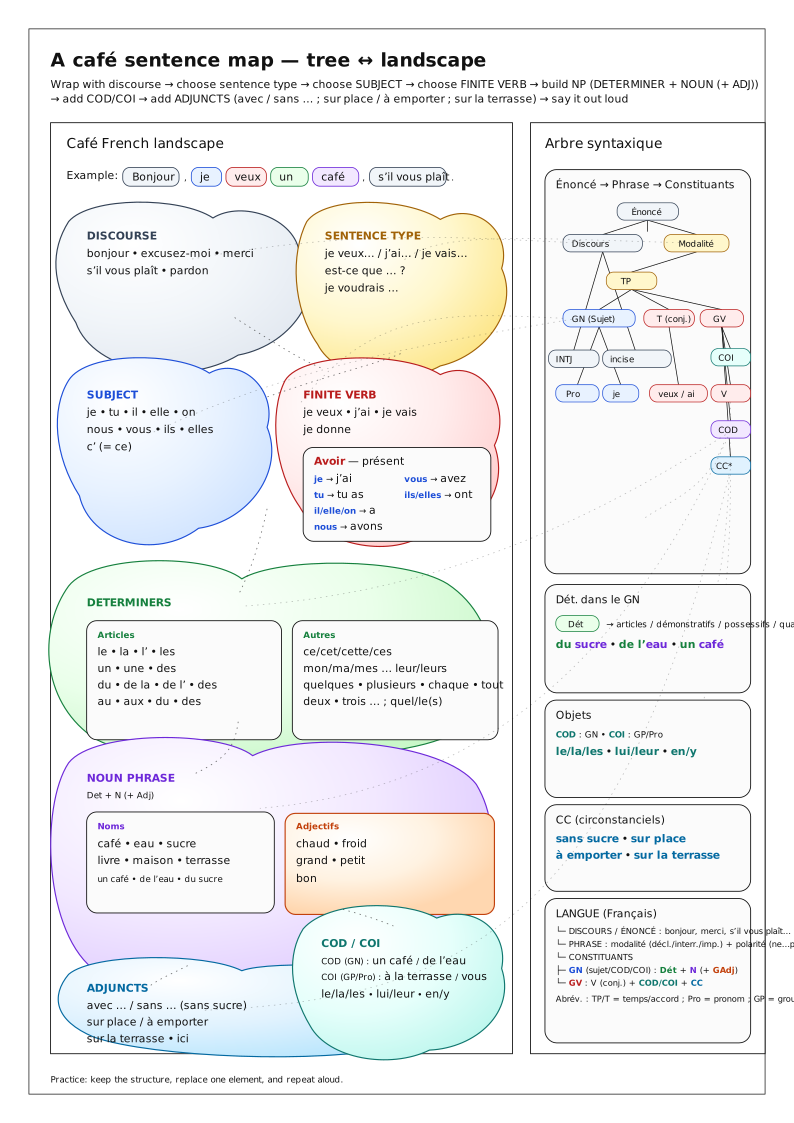
Figure 1.1: Sentence map (portrait)
What is a sentence map?
A sentence map is a diagram that shows how a sentence is built from smaller pieces. Each branch groups words into units (constituents) that behave together.
At beginner level, a tree is useful because it answers three practical questions:
- What must be present? (minimum to form a sentence)
- What can be added? (optional detail such as sans sucre or sur la terrasse)
- Where does it go? (word order: what comes before/after what)
In your tree, the backbone is:
- Enonce (utterance)
- Discours (greetings, politeness, discourse markers)
- Phrase (the clause proper)
- GN (Sujet) (who/what we are talking about)
- T (conj.) (the finite verb: the conjugated verb)
- GV (verb group: verb + objects + optional circumstantials)
The backbone of a beginner sentence
When you speak in a cafe, you usually produce a small utterance:
- a social wrapper (greeting, politeness)
- a core clause (who does what)
- optional add-ons (what, where, how, preference)
For TutorLumin beginners, a practical backbone is:
Subject + Verb + (Determiner + Noun) + (Optional extras)
Examples:
- Je voudrais un cafe, s’il vous plait.
- Je prends un cafe sans sucre.
- Je bois du cafe ici.
Noun group (GN): determiner + noun
One of the highest-payoff early habits is to learn nouns with their determiners:
- un cafe / un the
- de l’eau
- du sucre
This helps with gender, number, and “some/any” quantity patterns.
Add-ons you can stack
Beginner “extras” are often short and stackable:
- preference: sans sucre
- location: sur place / a emporter
- where: ici / sur la terrasse
The goal is to swap one part at a time while keeping the frame stable.
The parts of the sentence (in cafe terms)
1) Discours / Enonce (outside the clause)
These are the “social” words that make you sound like you belong in the interaction:
- salutations: bonjour
- politeness: s’il vous plait, pardon, excusez-moi
- thanks: merci
They can be placed before or after the clause without changing the grammar of the clause:
- Bonjour… + [clause] + …s’il vous plait.
- [clause] + …merci !
2) Modalite (sentence type)
Before you even pick your words, choose the type of sentence you need at the cafe:
- statement: Je veux… / J’ai… / Je vais…
- question: Est-ce que … ? (beginner-friendly)
- polite request (often taught as a chunk): Je voudrais…
For beginners, it is enough to master one reliable question format (est-ce que) and one reliable request frame (je voudrais), then expand later.
3) GN (groupe nominal): the noun phrase
A cafe sentence often revolves around a noun phrase: what you want, what you have, what you see.
A GN has a simple internal recipe:
Det + Nom (+ Adjectif)
This is one of the most powerful beginner discoveries: If you can build a GN, you can build an enormous number of cafe sentences.
4) GV (groupe verbal): verb + complements
The finite verb (conjugated verb) anchors the clause. In cafe talk, a few verbs go very far:
- je veux (I want)
- j’ai (I have)
- je vais (I’m going)
- je donne (useful for patterns)
From the verb, you can add:
- direct object (often a noun group): Je veux un cafe.
- indirect object (often with a or a pronoun): Je vous donne un cafe.
- circumstantial add-ons: sans sucre, sur place, a emporter, ici
A beginner method: build the sentence in layers
This supports a simple construction algorithm.
Step 1: start the interaction (optional but recommended)
- Bonjour…
- Excusez-moi…
- finish with: …s’il vous plait. / …merci.
Step 2: choose sentence type (mode)
- statement: Je veux…
- polite request: Je voudrais…
Step 3: choose the subject (GN sujet)
Most cafe sentences use je or nous. It is also useful to recognise neutral subjects like c’ in c’est.
Step 4: choose the finite verb (T)
Use a conjugated verb that matches the subject. Keep one frame stable while you practise.
Step 5: build the noun phrase (GN): det + nom (+ adj)
- un cafe
- de l’eau
- du sucre
Step 6: add objects if the verb requires it
Many beginner frames take a direct object: Je veux un cafe.
Step 7: add circumstantial details (CC): stackable extras
- sans sucre
- sur place / a emporter
- ici / sur la terrasse
Why this helps beginners
You do not need the whole language to speak. You need a small set of structures plus safe places to swap items.
This trains:
- chunking: stable frames (je veux…, je voudrais…)
- substitution: swap one element (noun / determiner / add-on)
- repair: adjust one node instead of scrapping the whole sentence
Verb tables (present tense)
The present tense
Être (to be)
| Pronoun | Form |
|---|---|
| Je | suis |
| Tu | es |
| Il/Elle | est |
| Nous | sommes |
| Vous | êtes |
| Ils/Elles | sont |
Avoir (to have)
| Pronoun | Form |
|---|---|
| J’ | ai |
| Tu | as |
| Il/Elle | a |
| Nous | avons |
| Vous | avez |
| Ils/Elles | ont |
Prendre (to take)
| Pronoun | Form |
|---|---|
| Je | prends |
| Tu | prends |
| Il/Elle | prend |
| Nous | prenons |
| Vous | prenez |
| Ils/Elles | prennent |