Le Cafe
This lesson is made of three atoms. You can study them in order (chapter mode), or mix and match across the course.
Introduction
“Oh ! un rhinoceros !”
Jean (Eugene Ionesco)
This lesson begins in a cafe, in which we learn to make an order and describe our surroundings. Imagine the pastries behind the counter, the steam rising, and the background chatter in a foreign tongue.
The aim is not to memorise everything. It is to speak early, with a repeatable method, and to gain fluency by swapping one part at a time.
Situation: ordering in a cafe
Reflex phrases
- Bonjour !
- S’il vous plait.
- Merci.
- Pardon ?
Ordering frames
- Je voudrais ____ , s’il vous plait.
- Je prends ____ .
- Vous avez ____ ?
Useful add-ons
- sans sucre
- sur place
- a emporter
Mini-dialogue (practice out loud)
Vous: Bonjour ! Je voudrais un cafe, s’il vous plait.
Serveur: Sur place ou a emporter ?
Vous: Sur place, merci.
Plates (use these to point and speak)
The menu (try to recognise words)
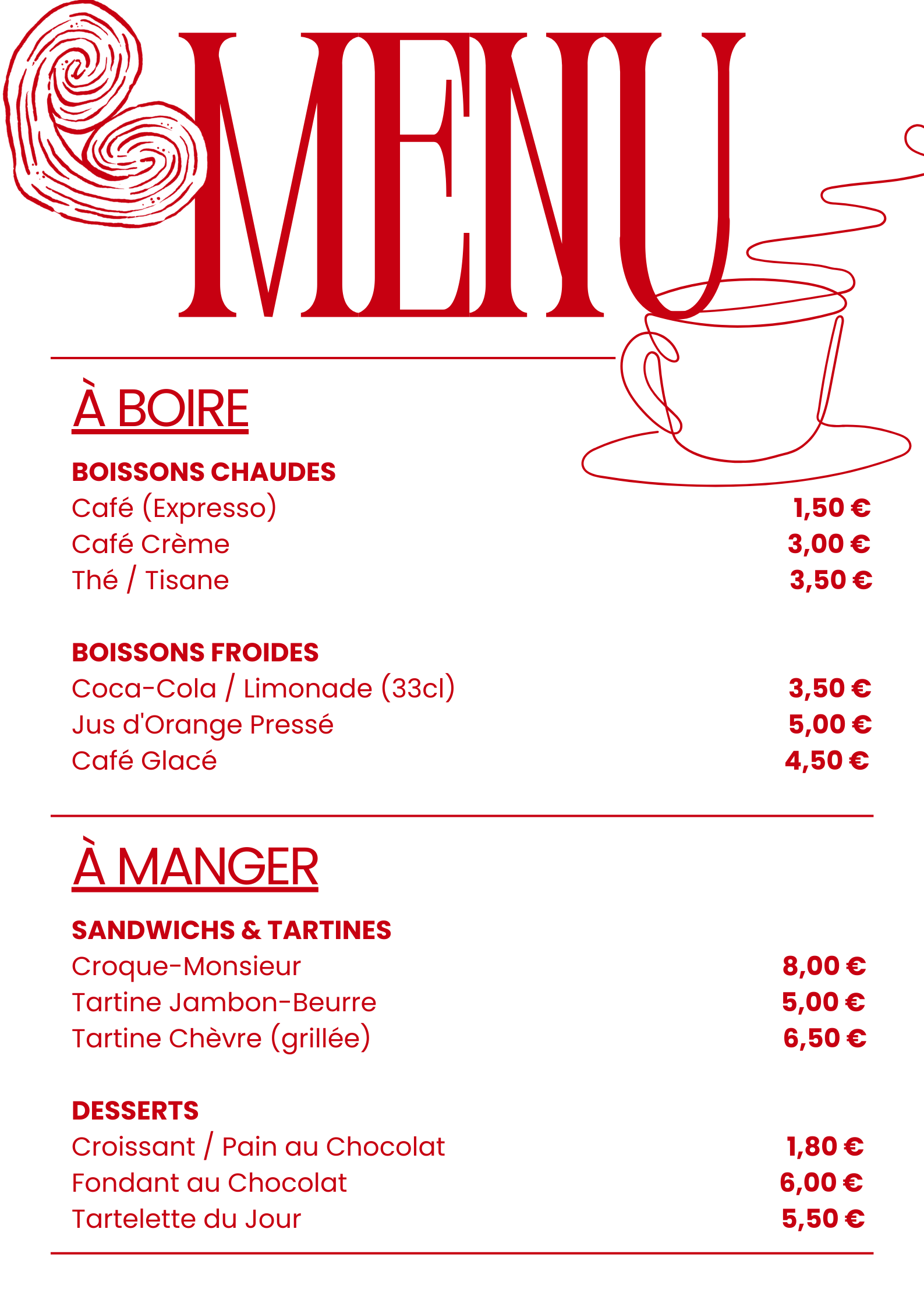
Figure 1.1: Cafe menu
Sketch and floorplan (describe what you see)
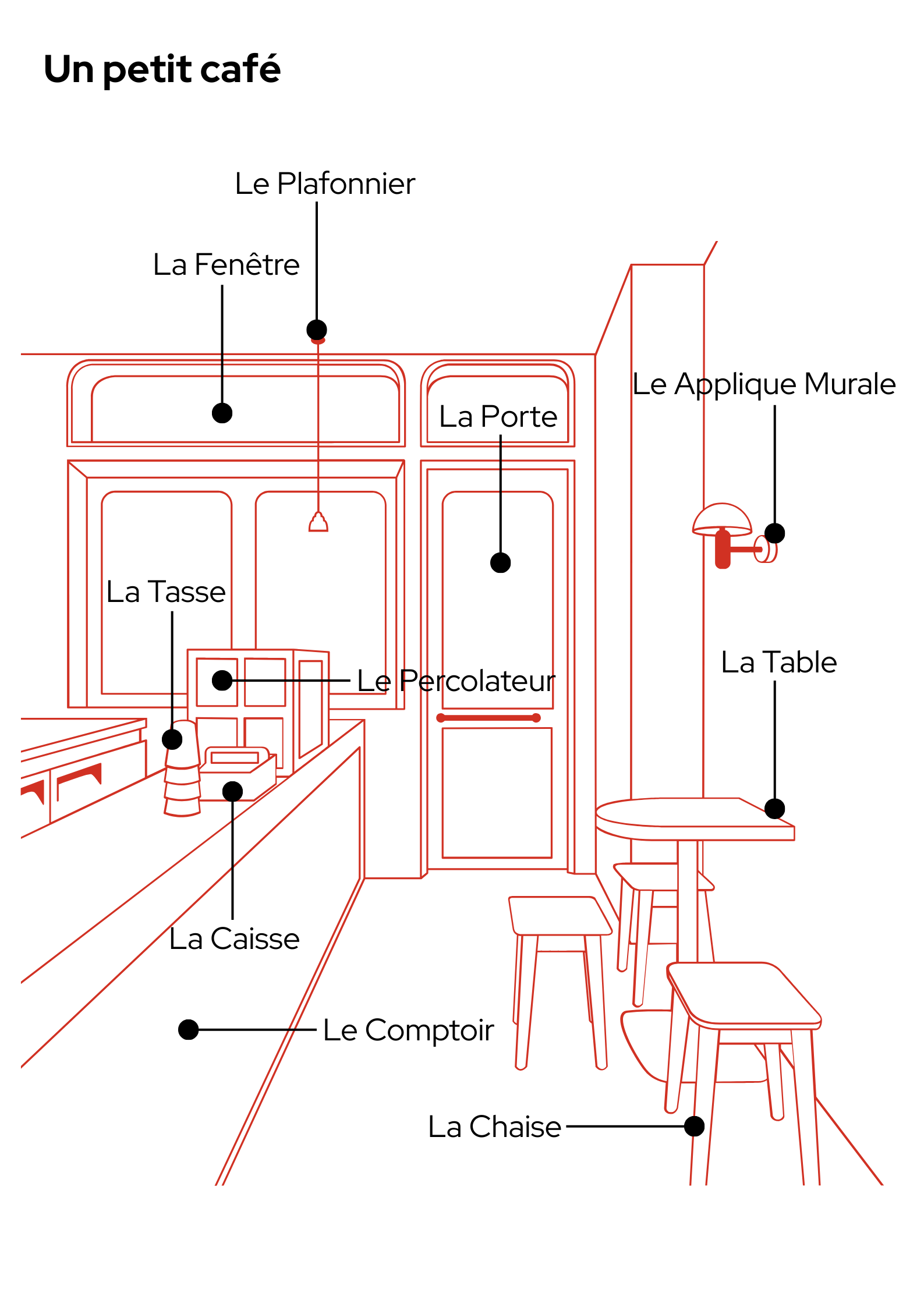
Figure 1.2: Cafe sketch
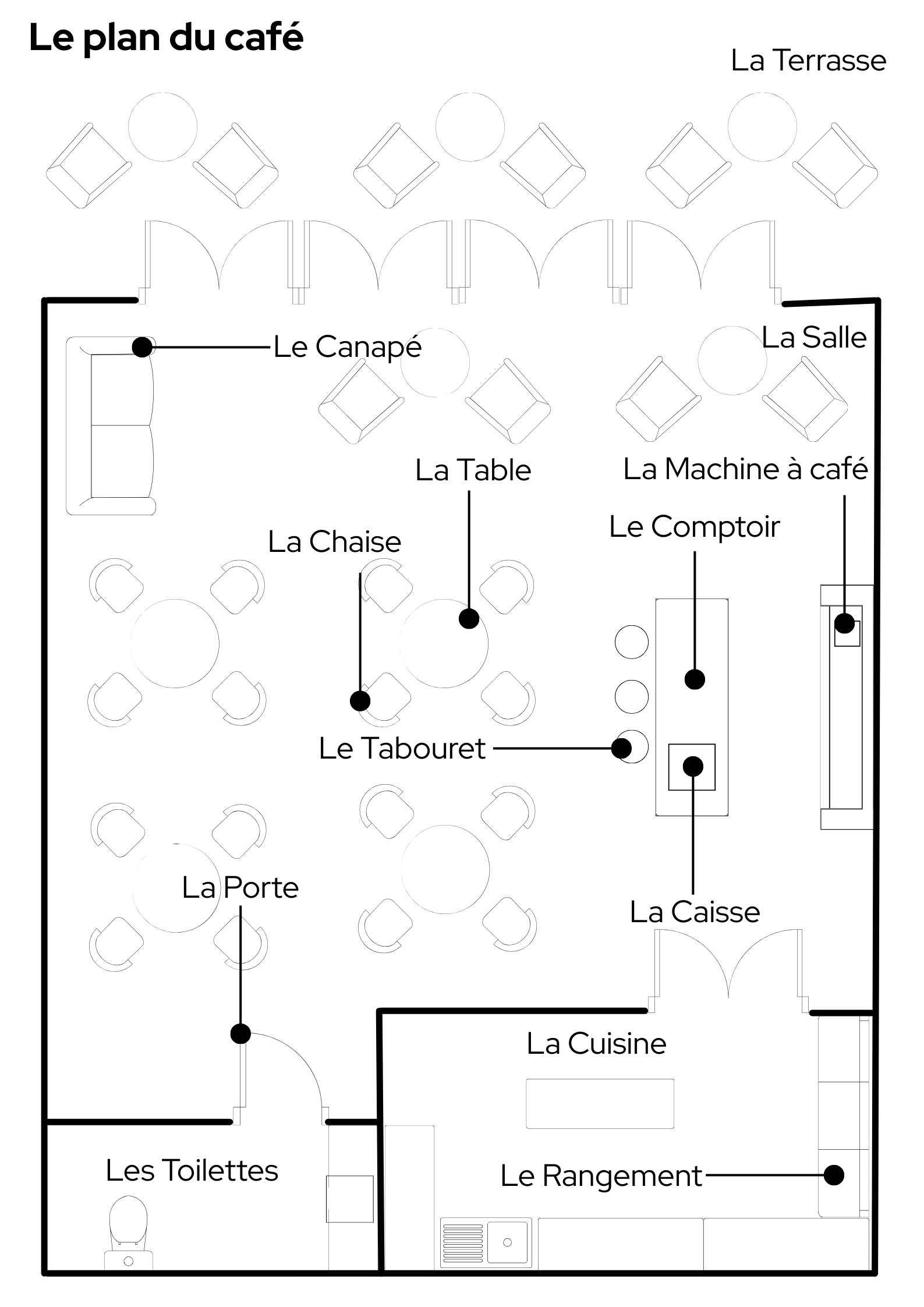
Figure 1.3: Cafe floorplan
Vocabulary (cafe)
Cafe vocab
L'Établissement & Les Espaces
| French | English |
|---|---|
| Le Café / Le Bistrot | The cafe itself. |
| La Salle | The main indoor room. |
| La Terrasse | The outdoor terrace (très important !). |
| Le Comptoir / Le Zinc | The bar counter. |
| Les Toilettes / Les WC | The restrooms. (Signs often say “Toilettes” or “WC”.) |
Le Mobilier (Furniture)
| French | English |
|---|---|
| La Table | Table. |
| La Chaise | Chair. |
| Le Tabouret | Stool (at the bar). |
| La Banquette | Booth/bench seating (often in red leather). |
| Le Fauteuil | Armchair. |
| Le Canapé | Sofa (more common in modern “salons de thé”). |
| Le Guéridon | Small, round table (classic on terraces). |
Les Éléments (Fixtures & Features)
| French | English |
|---|---|
| La Porte | Door. (La porte d’entrée: entrance door). |
| La Fenêtre | Window. |
| Le Store | Awning/blind (over the terrace). |
| Le Chauffage | Heater (on the terrace). |
| Le Cendrier | Ashtray (on terraces where smoking is allowed). |
| Le Rangement | Storage. |
Le Personnel (Staff)
| French | English |
|---|---|
| Le Serveur / La Serveuse | Waiter/Waitress. |
| Le Barman / La Barmaid | Bartender. |
| Le Patron / La Patronne | The owner/manager. |
| Le Bistroquier | Colloquial for cafe owner. |
| Le/La Caissier(-ère) | Cashier. |
| Le Plongeur / La Plongeuse | Dishwasher. |
| Le Chef / Le Cuisinier | Chef/Cook (for a kitchen preparing food). |
| Le Garçon | Old-fashioned term for waiter, still sometimes used. |
Les Actions & Verbs
| French | English |
|---|---|
| Servir | To serve. |
| Prendre une commande | To take an order. |
| Débarrasser | To clear (a table). |
| Préparer / Faire | To prepare / To make. |
| Cuire / Griller | To cook / To grill (e.g., a Croque-Monsieur). |
| Régler / Payer | To pay the bill. (“L’addition, s’il vous plaît”). |
| Servir à boire | To serve drinks. |
| Nettoyer | To clean. |
Objets Utiles (Useful Items)
| French | English |
|---|---|
| La Soucoupe | The saucer (for the coffee cup). |
| La Souche / Le Ticket | The receipt. |
| Le Plateau | Tray. |
| La Carafe d’eau | Water pitcher (often free on tables). |
| La Machine à café | Espresso machine. |
| Le Percolateur | Coffee maker. |
| La Tasse | Cup. |
| Le Verre | Glass. |
Petits Plus (Atmosphere)
| French | English |
|---|---|
| L’Ambiance | The atmosphere. |
| L’Apéro (Apéritif) | Pre-dinner drink time. |
| La Tranquillité | Quietness. |
| Le Brouhaha | Hubbub, noise. |
| L’Ombre / Le Soleil | Shade / Sun (for choosing a spot on the terrasse). |
Grammar: the sentence map (foundations)
The point is not to memorise “all the grammar”. The point is to learn a repeatable method for building correct beginner sentences.
From cafe scene to sentence
In a cafe you rarely produce a single word in isolation. You produce an utterance: a small package of meaning that begins with social signals (greeting, politeness), contains a core clause (who does what), and often ends with small details (preferences, location, time).
The sentence map gives you two complementary views:
- a tree (what depends on what)
- a landscape (the choices you can “walk through” to build your own sentence)
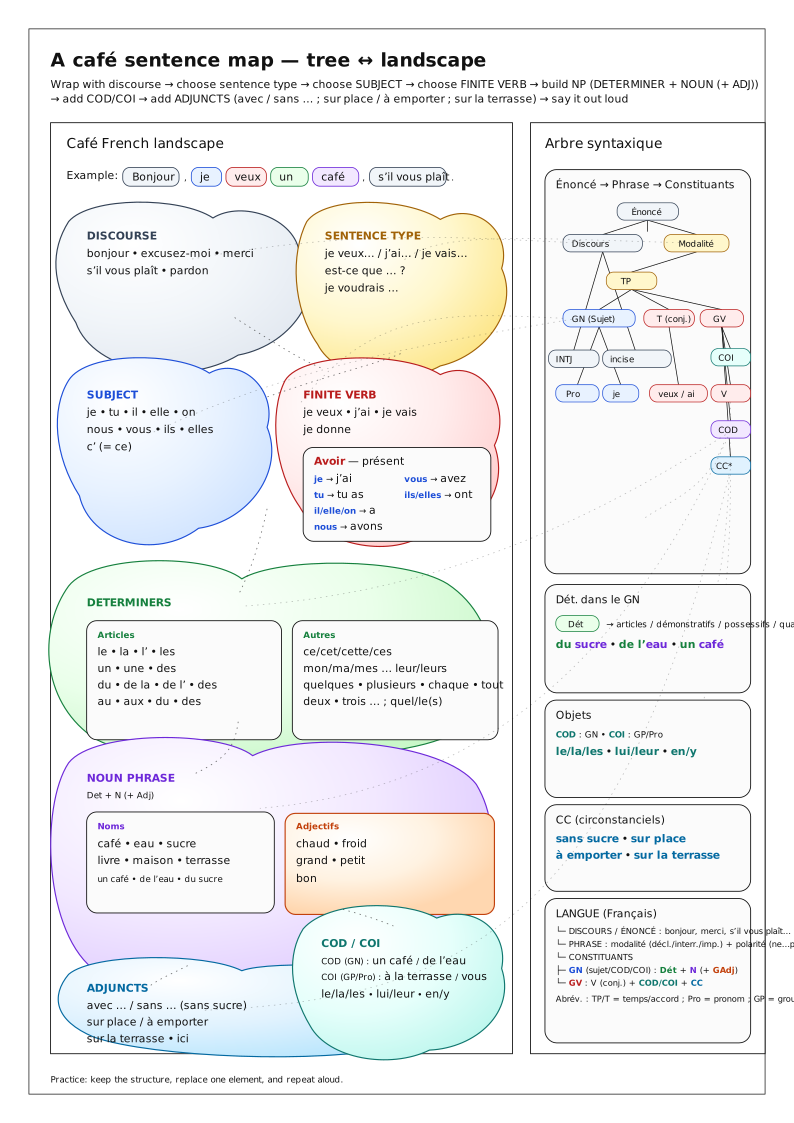
Figure 1.1: Sentence map (portrait)
What is a sentence map?
A sentence map is a diagram that shows how a sentence is built from smaller pieces. Each branch groups words into units (constituents) that behave together.
At beginner level, a tree is useful because it answers three practical questions:
- What must be present? (minimum to form a sentence)
- What can be added? (optional detail such as sans sucre or sur la terrasse)
- Where does it go? (word order: what comes before/after what)
In your tree, the backbone is:
- Enonce (utterance)
- Discours (greetings, politeness, discourse markers)
- Phrase (the clause proper)
- GN (Sujet) (who/what we are talking about)
- T (conj.) (the finite verb: the conjugated verb)
- GV (verb group: verb + objects + optional circumstantials)
The backbone of a beginner sentence
When you speak in a cafe, you usually produce a small utterance:
- a social wrapper (greeting, politeness)
- a core clause (who does what)
- optional add-ons (what, where, how, preference)
For TutorLumin beginners, a practical backbone is:
Subject + Verb + (Determiner + Noun) + (Optional extras)
Examples:
- Je voudrais un cafe, s’il vous plait.
- Je prends un cafe sans sucre.
- Je bois du cafe ici.
Noun group (GN): determiner + noun
One of the highest-payoff early habits is to learn nouns with their determiners:
- un cafe / un the
- de l’eau
- du sucre
This helps with gender, number, and “some/any” quantity patterns.
Add-ons you can stack
Beginner “extras” are often short and stackable:
- preference: sans sucre
- location: sur place / a emporter
- where: ici / sur la terrasse
The goal is to swap one part at a time while keeping the frame stable.
The parts of the sentence (in cafe terms)
1) Discours / Enonce (outside the clause)
These are the “social” words that make you sound like you belong in the interaction:
- salutations: bonjour
- politeness: s’il vous plait, pardon, excusez-moi
- thanks: merci
They can be placed before or after the clause without changing the grammar of the clause:
- Bonjour… + [clause] + …s’il vous plait.
- [clause] + …merci !
2) Modalite (sentence type)
Before you even pick your words, choose the type of sentence you need at the cafe:
- statement: Je veux… / J’ai… / Je vais…
- question: Est-ce que … ? (beginner-friendly)
- polite request (often taught as a chunk): Je voudrais…
For beginners, it is enough to master one reliable question format (est-ce que) and one reliable request frame (je voudrais), then expand later.
3) GN (groupe nominal): the noun phrase
A cafe sentence often revolves around a noun phrase: what you want, what you have, what you see.
A GN has a simple internal recipe:
Det + Nom (+ Adjectif)
This is one of the most powerful beginner discoveries: If you can build a GN, you can build an enormous number of cafe sentences.
4) GV (groupe verbal): verb + complements
The finite verb (conjugated verb) anchors the clause. In cafe talk, a few verbs go very far:
- je veux (I want)
- j’ai (I have)
- je vais (I’m going)
- je donne (useful for patterns)
From the verb, you can add:
- direct object (often a noun group): Je veux un cafe.
- indirect object (often with a or a pronoun): Je vous donne un cafe.
- circumstantial add-ons: sans sucre, sur place, a emporter, ici
A beginner method: build the sentence in layers
This supports a simple construction algorithm.
Step 1: start the interaction (optional but recommended)
- Bonjour…
- Excusez-moi…
- finish with: …s’il vous plait. / …merci.
Step 2: choose sentence type (mode)
- statement: Je veux…
- polite request: Je voudrais…
Step 3: choose the subject (GN sujet)
Most cafe sentences use je or nous. It is also useful to recognise neutral subjects like c’ in c’est.
Step 4: choose the finite verb (T)
Use a conjugated verb that matches the subject. Keep one frame stable while you practise.
Step 5: build the noun phrase (GN): det + nom (+ adj)
- un cafe
- de l’eau
- du sucre
Step 6: add objects if the verb requires it
Many beginner frames take a direct object: Je veux un cafe.
Step 7: add circumstantial details (CC): stackable extras
- sans sucre
- sur place / a emporter
- ici / sur la terrasse
Why this helps beginners
You do not need the whole language to speak. You need a small set of structures plus safe places to swap items.
This trains:
- chunking: stable frames (je veux…, je voudrais…)
- substitution: swap one element (noun / determiner / add-on)
- repair: adjust one node instead of scrapping the whole sentence
Verb tables (present tense)
The present tense
Être (to be)
| Pronoun | Form |
|---|---|
| Je | suis |
| Tu | es |
| Il/Elle | est |
| Nous | sommes |
| Vous | êtes |
| Ils/Elles | sont |
Avoir (to have)
| Pronoun | Form |
|---|---|
| J’ | ai |
| Tu | as |
| Il/Elle | a |
| Nous | avons |
| Vous | avez |
| Ils/Elles | ont |
Prendre (to take)
| Pronoun | Form |
|---|---|
| Je | prends |
| Tu | prends |
| Il/Elle | prend |
| Nous | prenons |
| Vous | prenez |
| Ils/Elles | prennent |
This activity page is where practice and checking happens. Treat the quiz as a quick gate before you move on.
Activity: cafe roleplay + quiz
A short practice routine
- Fix a frame: Bonjour, je voudrais… s’il vous plait.
- Swap only the noun phrase (5-10 repetitions):
- un cafe -> de l’eau -> du sucre
- Add one add-on (still keeping the same frame):
- Je voudrais un cafe, sans sucre.
- Only after it feels easy, change sentence type:
- Est-ce que je peux avoir un cafe ?
Each repetition is one small walk through the landscape.
Spoken drill (tennis)
Do 10 rounds. Keep it fast.
Person A (orders):
- Bonjour ! Je voudrais ____ , s’il vous plait.
Person B (questions):
- Sur place ou a emporter ?
- Avec ou sans sucre ?
Swap roles.
Before you move on
Take the quiz at the bottom of the activity page and aim to pass it cleanly without looking things up.
Quiz
Le Cafe Quiz
Pass this quiz before moving on. Aim to answer without looking things up.